


Every Sunday at church, I see families rolling in with their loved ones in wheelchairs and four-wheelers. Stroke survivors who cannot walk, kids who have severe disabilities, and adults paralyzed from accidents. We do not look at them and say it is time to let them go. We build ramps, we adapt our homes, we pour everything we have into their lives because they are family. We fight for every single day and every small joy, no matter how much care they need. So why do we play God so quickly with our pets?
That question hits different when you live it. Most of us who love our dogs think we are ready for the hard stuff, but when the moment comes, the system has already decided for us. I am talking about the veterinarian industrial complex and how it pushes euthanasia on our family pets way too fast. I am talking about your dog or cat, the one who has slept on your bed, greeted you at the door, and been part of your everyday life for years.

My dog Daisy is sixteen and a half now. She had a spine injury in 2015, which left her back half paralyzed. According to all the veterinary medical experts we have seen, she should have been gone a long time ago. The fact that she is still here 11 years later, still barking when she needs assistance to go potty outside, still chilling while riding around on her four-wheeler, is why I feel the need to share her story. She made it this far because I kept exercising God’s given common sense with each dreaded ultimatum.
Back in 2015, everything changed in one incident in the yard. She slipped on the muddy ground during her routine squirrel chase-play. Daisy hurt her spine, and the bottom half of her body went paralyzed. I took her to our vet within less than an hour, and referred her to a neurologist who studied the CT scan and basically shrugged. “No surgery can fix this,” he said. “Nothing we can really do.” They left me standing there feeling lost and pretty much pointed toward letting her go. I could not accept that. I took a whole month off work to stay with her every single day, figuring out my options.
I found a rehab veterinarian who is also an acupuncturist. We scheduled her for physical therapy, hydrotherapy, and acupuncture sessions afterward. We brought her there three times a week, and three weeks later, her bladder muscles recovered. I remember how ecstatic I was when she squatted and peed on her own again. A year after that, she was back to about seventy-five percent of normal. The same experts who said her future was bleak looked surprised.

Then in 2022, Daisy started panting hard at night, pacing the room, restless. Another vet did the exam and told me it was a sign of dementia, and nothing would reverse that. They dispensed 300mg of gabapentin for better rest at night. I refused to believe the diagnosis. I didn’t administer the prescribed drug because I knew the drug would only blanket the symptoms, without addressing the root of the problem. This was the same dog who still recognized me, knew every spot in the yard, and never once got lost on the way to her favorite sleeping place. How could it be a sign of dementia? I scheduled a full exam with an internal medicine specialist. Turns out Daisy’s blood pressure was over two hundred. We started benazepril, and in two weeks the panting and pacing completely stopped. She was herself again.

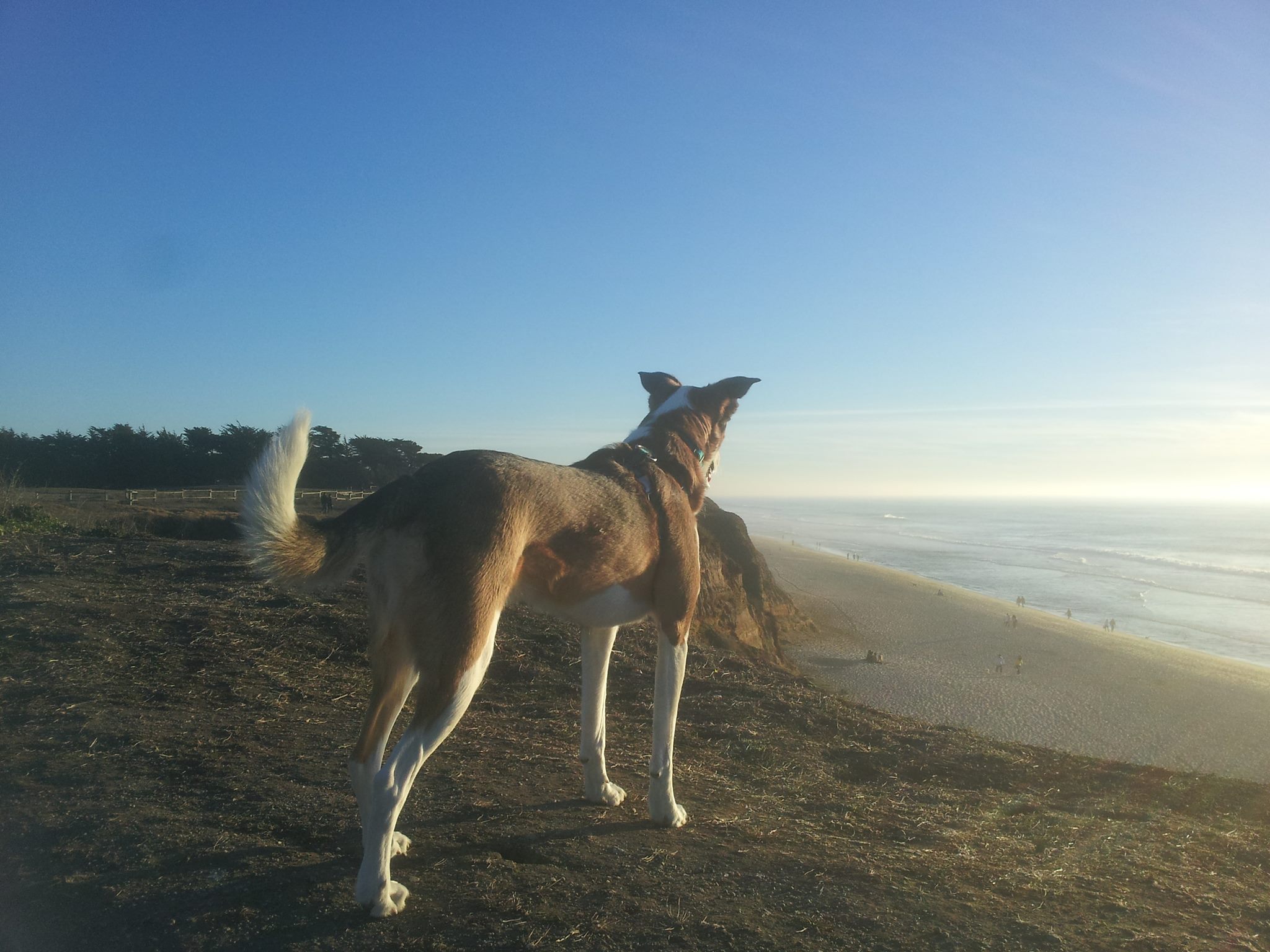
The pattern kept repeating. In July 2024, she lost control of her hind legs for a bit but got thirty to forty percent back after a few days of physical therapy. We took her and her sister Jasmine to walk on the beach in October 7, 2024, and February 27, 2025. It was a fun and humbling experience to walk on the beach with two fifteen-year-old dogs. We knew Daisy’s past incident had caused the degenerative condition, and this was the slow progression from that 2015 spine injury.

March 2025, Daisy’s hind legs weakened, and she was kinda agitated and restless. The vet looked at her age, fifteen at the time, and said she was tired, giving me that familiar hint that it was time. I pushed for tests anyway. It turned out she had a bladder infection. We treated it with antibiotics, and her spirit came roaring back. However, we are aware that her mobility wasn’t going to improve. By August 2025, she had completely lost control of her hind legs. She is unable to get up on her own anymore, so I moved into her bedroom to assist her at night. The second she barks, I am right there to help bring the water bowl to her or assist her with the Help’Em Up harness to go potty outside.
From that point, we restarted weekly acupuncture sessions. It helps ease the stiffness from her lack of mobility, and since the acupuncturist is also a vet, it’s a good way to keep everything casually monitored more regularly. I always ask if Daisy is in any pain. The answer was always no.

To be clear, here are the facts: Even with full paralysis in her back legs, her brain is still perfectly coordinated with her bladder muscles. She barks every single time she needs to go potty. She does not like to soil her bed at all. She is fully aware of her cleanliness. We have almost zero accidents. She is not in pain. She is fully alert. She knows when she needs to go out. When her acupuncturist vet mentioned the euthanasia option, I said I would leave that decision to Daisy and God when her time is really up. She respects my decision.
A week after that conversation, I casually mentioned my wish to find someone who could customize a mobility cart for Daisy, so she could go on outings like she used to. I showed her an image I saved from the internet. She asked one of her staff to go to the back room and see if there was a four-wheeler. The staff returned with an almost brand-new-looking four-wheeler. When I looked at it, I felt like this was sent from heaven, because it looked exactly as I had in mind. The vet asked two of her technicians to do the fitting, and I can’t believe there was absolutely no need for any adjustment. Daisy fit right in. The four-wheeler is loaned to Daisy. From that day, Daisy had some outing adventures, from visiting the local farmers market, chilling at a friend’s backyard, as well as receiving a spontaneous blessing from an Episcopal priest on a sidewalk during one of the weekend outings. Last week, we had her blessed with holy water by our pastor at the Church’s parking lot.

The compassionate reason behind the push by those who supposedly care the most can sometimes feel superficial. In today’s veterinary world, euthanasia is often presented as the default first option the moment things get complicated with senior or disabled dogs. It’s a convenient option, and at the same time, it builds surges in supply and demand for anesthesia and euthanasia drugs. Just follow the money trail. It is designed to bring in several hundred bucks for pharmaceuticals and another several hundred for the pet crematorium industry.
I am not saying every euthanasia decision was wrong, but pet owners need to be aware of the reality and how many beloved pets were ripped from their lives far too soon. I feel blessed every morning I wake up next to Daisy, and she is still present with me. It’s truly day by day. I know the toll it takes on her and me. We gave up our social life because we couldn’t leave Daisy alone. I am sharing this story now because it helps me prepare for the grief when the time finally comes. Daisy proves the norm is wrong too many times, and I am thankful I have been with her every step of the way.

If your pets are not terminally ill, still mentally sharp, show no pain, still signal what they need, and still light up for little things like a car ride or fresh air, do not let the industry rush you on this irreversible decision. Get second opinions. Fight the default script. Daisy proves the norm is wrong too many times.
When the End Is Near: Counting the Last Days into Hours.
On Tuesday, June 30, 2026, I had made a perfect plan. Everything was organized, and everyone was ready. We were ready, the vet was ready, and the crematory staff had been notified of the booking.
Then, out of nowhere, Daisy showed all the signs that she wasn’t ready. She barked (she hadn’t barked for days), and her eyes tried to communicate. She was scared. I know the next move I make will split opinions. Logically, sedation can control and suppress the fear. Most people would take that option because she is not going to get better and regain any quality of life. If I weren’t in the room seeing her, I would probably agree. But I was there. I witnessed the hesitation and pleading eyes.
I don’t know what was in her mind, but I know one thing: I will not live the rest of my life regretting my decision or forcing my way over her wish. I can’t let Jasmine witness that, because she is watching every little thing I do to her sister. I will not do anything she does not want me to do.
Looking back, I probably should not have rushed the exit. I was worried about her suffering, but then I looked at her. She is completely relaxed, her breathing is slow but steady. No drooling, no panting, no short breath. We want to prevent her from experiencing any discomfort or pain. However, with proper hospice care, she is comfortable and pain-free. I pay attention to every detail to prevent eye and mouth dryness. I use artificial tear drops and administer sub-fluids daily. She still swallows the liquid up. I have said my long goodbyes. I keep telling her not to be scared. Jasmine stays close, watching over her sister of 15 years and 6 months. I am simply here with them, letting Daisy tell me when she is ready.

I think we all need to listen to our hearts when involving our loved ones in their end-of-life decisions. I think dogs are just like people; some people prefer to get assisted suicide when they are dealing with terminal illness, and some people have faith in God to carry them to the end.
In Daisy’s situation, her will to live is beyond her body’s strength, and she was not willing to give up her authority to call her own shots. This is the same dog that has been through a lot. She was abused in her puppy age. I adopted her from the shelter at 1 year old. She growled at every man who tried to approach her in her kennel.

The NO KILL shelter, Oregon Humane Society, planned to make her a statistic. In the eyes of the law, a NO KILL SHELTER can kill any dogs/cats if they are deemed behavioral unfit to get adopted. I got a call from an insider during my lunch with friends. I left the restaurant right away and headed to OHS. They did not want to release her, and I refused to leave. Finally, they called their independent behaviorist to talk to me. I got her out with a signed waiver that I released OHS from any liabilities.
I spent the first 2 years working to earn her trust. When she finally did, she came out from her bedroom in the middle of the night, knocked down my flat screen TV to the ground, and woke us up. She ran back to her room, frightened. I went to her room, comforted her, and told her it’s okay. That was the beginning of our special relationship. She thought we would be mad, but instead, we showered her with love and gratitude that she decided to come out and accept us as her mom and dad. Dogs know. We had a few great years, with her at her peak, fast like the wind, wicked funny.


In the rescue community, we used to call her “Lieutenant D”.


In 2014, Daisy tore her left ACL. Left TPLO was performed on July 10, 2014. She recovered well with 8 weeks of restricted activities, followed by water therapy at a doggie swimming pool near my workplace. Then, in December 2015, everything changed in one incident in the yard, when she tried to chase the squirrel and slipped on the ground. She was in so much pain that she almost died on the spot. When she was about to get unconscious, my husband yelled the magic word she never fails to respond to, “MOMMY”. I was at work, immediately left work, and I called Dr. Hoffman’s office, told the front desk to tell Dr. Hoffman to be ready in 15 minutes to help Daisy. I did not let them respond because I knew they would have referred me to the ER, and that would have been a huge mistake. I hung up the phone before they could respond.
I got Daisy in within 15 minutes, and sure enough, Dr. Hoffman was ready to render the first aid. She got the steroid injection on her spine right away (it is a very important step on any dog with spinal injury to get that injection within 3 hours of the incident; that one action alone will determine if the dog can ever walk again or not). That was exactly the reason why I did not take a chance & take her to the ER instead. With the ER, it is always a gamble; in most cases, we won’t get the help on time in a situation like that. That was 11 years ago. The rest of the story was revealed at the beginning of this article.

In the ten days that followed that entry, the weight of my decision grew heavier, not from the physical toll of caregiving, but from the sharp sting of isolation. When my old parents went through this same stage (stage 4 kidney failure and liver failure), we provided them with this identical hospice care. In the human world, we were praised as good, compassionate children. We were carrying out a sacred duty. But when I implemented the same thought process and actions for Daisy, the demeanor of the veterinary world and even close friends shifted overnight. I was met with coldness, judgments, and heavy comments that I was “dragging this out” and that euthanasia was the only moral choice.
I found myself trapped in a painful social double standard, totally isolated from the accepted norms. Society has become so accustomed to a quick, clinical exit for pets that witnessing the slow, quiet, and natural winding down of a body looks like cruelty to them. They didn’t understand what I knew intimately from my parents: that the natural buildup of toxins in end-stage failure acts as a profound, built-in sedative. Some people probably couldn’t see past their own discomfort with death, leaving me to hold vigil in a lonely vacuum of disapproval. I held the line because I promised I would listen to Daisy. I wish no one ever had to go through this phase of life. I wish we could all just fall asleep peacefully one night and never wake up. But if my time comes, I hope someone will do for me what I am trying to do for Daisy: listen, respect my wishes, and stay with me until the end.

Then, yesterday, it finally unfolded. As her organ failure reached its natural completion, her swallowing reflex faded, and I stopped all water, knowing that the risk of choking was the only thing that could break her peace. I keep her mouth moist with damp cotton balls. Her heart beat with an incredible, defiant strength, making me wonder how much longer this ancient body could endure. But Daisy knew exactly when it was time.

While I was sitting right beside her, she did something she hadn’t done in weeks: she shook her head just once. It was a gentle, quiet signal to her brain; a final letting go. Immediately after, her body completely relaxed, releasing its final waste. I reached out and pet her head. She took three gentle motion with her mouth; clearings of the throat. There was no gasping, no panting, and absolutely no struggle. And just like that, she was gone, timestamped 5:40PM on July 9, 2026. It was entirely, perfectly peaceful.Looking at her still, resting body, the heavy cloud of judgment from the outside world completely dissolved. The validation didn’t come from a vet, a tech, or a friend; it came from Daisy herself. By refusing to rush her exit, by choosing the lonely path of home hospice, I gave her a death of ultimate dignity she wanted. She departed from her earthly body in her own room, under the watchful, undisturbed gaze of her bonded sister Jasmine, and left on her own terms.I kept my promise. I listened, I respected her wishes, and I stayed with her until the very end.

To the best dog I have ever had, thank you for giving me the ultimate gift. Caring for you was an honor I took seriously. Now you get to watch and protect your sister Jasmine. I told her you are still around and have been assigned to be her personal guardian angel.


Thank you for the amazing journey. For 16 years, 7 months, and 4 days, you have done incredibly well.
updated July 12, 2026